Orthodontic treatment becomes unpleasant in many places when costs are revealed later. We think differently. On this page we describe exactly what costs you can expect during treatment.
The answer is simple: almost anyone! Thanks to modern braces, orthodontic treatment is no longer just for children and teenagers—we can effectively move teeth in adulthood too. Braces today are more aesthetic and comfortable than before, so go ahead with confidence. If you’ve been putting it off, you’re in the right place now!
During the consultation: If the condition of your teeth allows, the impression can be made at the first appointment. This can be done digitally or traditionally. For one arch, a traditional impression costs 5,000 HUF, digital is 10,000 HUF. Beyond the impressions, we need to assess the overall condition, so panoramic X-rays are essential for careful treatment planning. This is the part many patients don’t see, but this is where everything is decided. Based on the X-rays and impressions, Dr. Hamid creates a treatment plan according to precise professional criteria, which includes the treatment process and expected duration step by step. During placement: The price includes the appliance with all its additional elements and the placement! A fixed appliance treatment typically lasts 12–18 months. Important: in about 15-20% of cases, palatal expansion is also necessary. In this case, a so-called transpalatal arch must be placed. We order this from a master dental technician specializing in orthodontics and install it when placing the appliance. If this is needed, the cost is 39,000 HUF. Regular checkups are very important during orthodontic treatment so your treating doctor can continuously respond to tooth movement, as the planned fine, controlled movements are achieved through appliance adjustments. Adjustments are needed every 4–6 weeks. During these visits, we fine-tune and adjust the appliance, reposition or replace brackets if necessary, and change the wire on average every 3 months. The cost of wire replacement is 15,000 HUF/arch, which is in addition to the adjustment fee. When we are all satisfied with the achieved result, the braces are removed from the teeth and the doctor polishes the bracket sites. It varies by individual, but a thorough dental hygiene cleaning may also be necessary after removal. After this, a retainer (fixed and/or removable) is made to ensure the achieved result is maintained long-term, at a price of 39,000 HUF per arch.
Orthodontic treatment is not just about creating a harmonious smile. In many cases, crowded teeth are difficult to clean, making tooth decay and gum inflammation much more likely to develop. Beyond aesthetic perfection, we also focus on establishing the proper bite. This is very important because proper jaw loading can prevent jaw joint problems and jaw clicking from developing later.
Practicing orthodontics at a high level is a family tradition; even as a child, I wanted to follow in my father’s footsteps, who showed me the wonders achievable through orthodontics. After graduating from university, I was one of the few who could complete their specialist training directly under the President of the Hungarian Orthodontic Society, thus gaining access to the highest level of education. Armed with this knowledge and several years of experience, I wholeheartedly believe that orthodontics is not just about straightening teeth! I believe in complex orthodontics, where not only the alignment of the teeth but also their functionality is equally important. Therefore, I use the most modern orthodontic techniques in my treatments, as this is the guarantee for achieving lasting and aesthetic results.
Request an appointment by phone or send us a message—we can see you within 1 week. Premium city center clinic near Keleti Railway Station, flexible opening hours, treatments with warranty.
Premium dental implant (NeoDent Grand Morse) now only 139,000 HUF Together with a zirconia crown, from the first consultation to the post-treatment check-up, the complete package is discounted to 349,000 HUF, which includes every step and material involved in creating the implant-supported restoration.
The cost of dental implantation is often unclear in many places. Advertisements attract attention with a favorable partial price, such as the partial price of the implant fixture, but during treatment, costs continuously arise, and when calculated together, the price of an implant-supported restoration is nowhere near as favorable. Our goal is for patients who come to us to have complete clarity from the very first moment and to know exactly what they are paying for and what they are getting for their money. 1. The NeoDent Grand Morse implant is a premium-quality, reliable system for which we receive a preferred partner price from the Straumann Group, which manufactures NeoDent—we pass this discount on to our patients. 2. Our specialists have many years of experience in implant placement, so our rate of errors and warranty issues is 0%. 3. For the fabrication of zirconia crowns, our dental laboratory partner is Ab Ovo Digital Dental Lab, where every single step of prosthetic fabrication has been optimized to perfection thanks to digital advancements. As a result, they work cost- and time-efficiently, enabling them to guarantee the highest quality for us with short turnaround times. 4. Our clinic’s goal is to make implantation not a luxury, but an accessible solution for everyone who values stable chewing and a natural smile.
The complete treatment is 349,000 HUF instead of 414,000 HUF, WITH NO HIDDEN COSTS!
The treatment is painless, fast, and we are with you every step of the way. You will not be disappointed in our clinic and our specialists! Painless treatments with professional specialists, using premium materials.
Our goal is to communicate transparently and clearly during every single treatment. All this for 349,000 HUF, instead of the original 414,000 HUF! We have no hidden costs! Important: the prices listed here are valid only when the entire treatment is utilized
Request an appointment by phone or send us a message—we can see you within 1 week. Premium city center clinic near Keleti Railway Station, flexible opening hours, treatments with warranty.
Don't delay! Book an appointment online!
Creating dental restorations is one of the most important yet most complex tasks in dentistry, as achieving the right result requires many parties (patient-assistant-doctor-dental technicians) to work together.
There are many offers circulating, making it difficult to navigate. The zirconia or metal-ceramic restorations offered by Denteo can be this affordable for 2 reasons:
Replacing a missing tooth is important not only from an aesthetic perspective. Missing teeth affect chewing, everyday comfort, and overall well-being. If the gap remains untreated for an extended period, neighboring teeth may shift, leading to bite misalignment and further jaw problems. Additionally, the bone beneath the tooth begins to deteriorate over time, which makes it more difficult to create a future implant-supported restoration. This becomes a major issue if you lose more teeth over time and want stable, comfortable, and beautiful teeth in their place.
Due to the aesthetic and functional reasons mentioned above, we did not want to make any compromises, as we know that committing to dental restoration requires a major decision, and the right value for money plays an important role alongside aesthetics in making that decision.
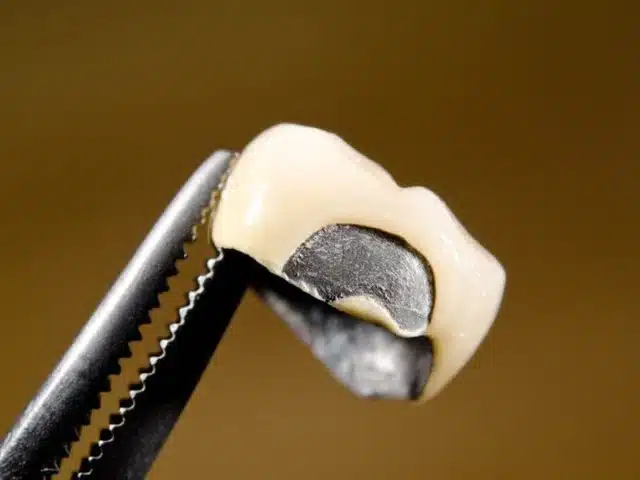
Crown or bridge restorations can be made from several types of materials. We always recommend the one that best suits our patient’s needs and possibilities. Zirconia is today’s most modern and beautiful solution for replacing a missing tooth or replacing a worn crown.
You will not be disappointed in our clinic and our specialists!
The price of dental restorations varies widely, so it is natural if you also find it difficult to navigate. Our goal is to communicate transparently and clearly during each of our treatments. The price of a crown or bridge restoration consists of the following items: In addition to the above prices – if the case warrants – the following may apply as extras:
However, depending on the condition being treated, additional supplementary treatments may become necessary (e.g., bridge cutting, root canal treatment, etc.), which may incur additional costs and are not covered by this offer. Missing teeth are not just an aesthetic issue: neighboring teeth begin to drift, chewing deteriorates, and later a larger intervention may be needed.
Request an appointment by phone or send us a message—we can see you within 1 week. Premium city center clinic near Keleti Railway Station, flexible opening hours, treatments with warranty.
We are committed to ensuring that all treatments are performed by a professionally trained colleague, which is why we at DENTEO also offer invisible orthodontics in the context of a specialist consultation. The first step in starting orthodontic treatment is always a consultation at the office, where a condition assessment can be carried out and needs and options can be discussed with the treating doctor. One of the biggest advantages of Smilezor® invisible orthodontics is that we can see real results after the design. We can see how long the treatment will take and how the position of the teeth will change step by step until the desired result is achieved. The delivery of the aligners always takes place in the dental office. At this time, the treating doctor will show you the plan and hand over the Smilezor® aligners required for the treatment. If necessary, he will perform other orthodontic treatments. The healthy and beautiful results achieved by Smilezor® orthodontics are certainly remarkable, but this is only half the battle, as the correct position of the teeth must also be maintained. Therefore, a so-called retention phase is always necessary after invisible orthodontics, the basic requirement of which is the wearing of a retainer.
For more detailed information, please visit the Smilezor® website: https://smilezor.hu/
Teeth whitening performed in the dental office is a completely pain-free and safe treatment. It is based on the so-called cold light procedure, which does not damage the tooth roots or the enamel.
Airflow polishing is performed using a special device. With this, we spray a mixed substance consisting of water, air, and very fine sand powder onto the affected teeth at high pressure.
Although many people are wary of it due to older versions, tartar removal is not at all painful, nor can it even be considered an unpleasant procedure.
A decayed tooth is aesthetically bothersome and can cause sensitivity and pain. If left untreated for too long, it can lead to even greater problems.
Whether we lose one or multiple teeth, we can turn to the solutions offered by dental prosthetics: dental crown, inlay, onlay, pressed ceramic veneer, removable denture.
A dental implant is an artificial tooth root that is placed into the bone by a specialist during an oral surgical procedure.
If a tooth cannot be saved, its removal becomes very important, as it can cause focal infections and inflammations in our body.
Since there can be several types of problems with it, it is very common that it needs to be extracted. Oral surgical removal of the wisdom tooth is the perfect solution for this.
Before tooth root removal, a panoramic X-ray is taken, followed by local anesthesia and then exploration of the affected area. In case of inflammation, the wound is cleaned and inflamed tissues are removed.
Apicoectomy is an oral surgical procedure during which a part of the tooth root, specifically the root tip, is removed along with the inflamed tissues around the root.
A dental abscess causes severe pain, swelling, and can lead to unexpected complications. Incision, or opening of the dental abscess, helps with this.
Our gums play an extremely complex role in maintaining the health of our mouth. Gum plasty can help with gum recession, gummy smile, and cervical sensitivity.
If periodontal disease or gum atrophy is not treated in time, it can unfortunately lead to serious problems such as loosening of teeth, and in the worst case, their loss. However, with periodontology treatment, diseases of the periodontium and gums can be stopped!
When the inside of the tooth has died, root canal treatment is the only option to avoid having the tooth removed. Its goal is to save your tooth instead of extracting it. However, you need to visit the dental office in time!
Digital dental X-ray diagnostics is an advanced technology that can create a complete, two-dimensional overview of all your teeth within minutes.
Today, orthodontic treatment for adult patients is just as common as for children. Some orthodontic appliances have been specifically designed to meet the aesthetic demands of adults.
Tooth decay is not just an aesthetic problem, but a process that threatens the health of teeth and gums. The acidic effect of bacteria in plaque gradually damages tooth enamel, which, if left untreated, can lead to cavities and even inflammation. Is your crown broken, loose, or discolored? Learn why a crown or bridge can fail and what you can do to prevent it. Japanese GC composite filling in a short time, with a natural appearance and premium material – we can provide an appointment within 1 week. A high-quality dental filling is a crucial dental procedure: the preservation, stability, and long-term health of a damaged tooth depends on it. Nothing is better than your own tooth!
The price of dental fillings can vary significantly between clinics, and many patients find it difficult to navigate. At Denteo Dental Clinic, Japanese GC fillings are available at such a favorable price for two reasons:
Tooth decay does not stop on its own – it continuously spreads and penetrates deeper into the tooth structure. If we wait too long, a filling will no longer be sufficient, and: An aesthetic filling done in time not only saves the tooth but also provides a stable, natural-looking result for many years.
The special feature of Japanese GC composite material is that it:
Dental filling is the most commonly used tooth-preserving treatment, which is necessary in the following situations:
The treatment is painless, quick, and you can eat anything again the same day, and the treated tooth will no longer interfere with your speech. You will not be disappointed in our clinic and our highly experienced specialists! Painless treatments with professional specialists, using premium materials.
Consultation and assessment Removal of the decayed part Building up the Japanese GC composite filling Light curing Polishing, bite adjustment Guarantee and follow-up
Our goal is to communicate transparently and clearly during every single treatment. However, during the preparation of the aesthetic filling, depending on the condition of the tooth to be treated, additional supplementary treatments may become necessary (e.g. additional X-rays, post, root canal treatment, etc.), which may involve additional costs and are not covered by this promotion. Tooth decay is not just an aesthetic issue: decay detected in time can be treated, potentially avoiding tooth loss. The sooner you act, the easier the solution.
Request an appointment by phone or send us a message—we can see you within 1 week. Premium city center clinic near Keleti Railway Station, flexible opening hours, treatments with warranty.
As part of our clinic’s special offer, we would like all of Budapest to get to know our excellent doctors, dental hygienists, and our brand-new, modern clinic. That’s why we invite everyone who cares about their oral hygiene to take advantage of this offer: instead of 22,000 HUF, we now perform ultrasonic tartar removal for both arches at perhaps the best price in Budapest, for 15,000 HUF, complemented with polishing and oral hygiene consultation. If you would also like to treat tooth discoloration at the most modern standard, we have made our combined tartar removal and dental air polishing (Airflow, also known as salt polish) package available for just 25,000 HUF! These prices are real! Precision and personalized attention are standard at our clinic, so you can be sure you’ll receive the highest level of expert care during your treatment Our offer is available for a limited time!
The Ab Ovo digital dental laboratory can deliver the highest quality to us. As part of our collaboration with them, for a limited time we are offering porcelain-fused-to-metal bridge units or crowns for 59,000 HUF, and zirconia bridge units or crowns for 79,000 HUF.
Adult orthodontics is becoming increasingly popular, and it’s never too late to start if you want a more beautiful smile! Thanks to modern techniques today, orthodontic treatment is not only available for children and teenagers.
We invite everyone who cares about their oral hygiene to take advantage of Budapest’s best price: instead of 22,000 HUF, we now offer ultrasonic tartar removal for both arches at 15,000 HUF, complemented with polishing and oral hygiene consultation.
We perform fillings using materials from the Japanese company GC, whose quality far exceeds most materials available on the market, guaranteeing durable and aesthetically pleasing results that you cannot get elsewhere at this price.
Premium dental implant (NeoDent Grand Morse) and zirconia crown from the initial consultation to post-treatment follow-up at a special price of 349,000 HUF. The package includes every step involved in creating an implant-based dental prosthesis.
We welcome you to our impressive dental practice located in the 7th district of downtown Budapest! We welcome you to our impressive dental clinic located in the district!
Budapest, 7th districtFixed braces at a super price
189,000 HUF / archYes, you read that right:
189,000 HUF
Who is adult orthodontics recommended for?
Adult orthodontics is especially recommended for:

How much does orthodontic treatment cost? – Full price, no hidden costs
1. Consultation – 19,000 HUF
2. X-ray and impression – if treatment can start immediately – from 10,000 + 5,000 HUF
3. Treatment plan – 19,000 HUF
4. Fixed appliance placement – 189,000 HUF / arch
5. Adjustments – 15,000 HUF / visit
6. Braces removal 29,000 HUF


Orthodontics is more than aesthetics
Renewed Smiles


Why is it worth getting your orthodontic treatment with us?
Transparent prices, no hidden costs
Exceptionally good value dentistry in Budapest
Professional and very friendly orthodontist
Advantages of Denteo Dental Clinic

<em>Patient</em> <b>REVIEWS</b>
Your orthodontist

Dr. Hamid Darban
Are you ready to save your tooth and avoid more extensive treatments?

Dental implant at an unbeatable price, for 139,000 HUF!
Our offer is available for a limited time!

How can an implant-supported restoration be this affordable?
Our implantation package is so favorable because:

What does the 349,000 HUF dental implant price include?
Prosthodontic consultation
10,000 HUF Credited toward the cost of the restoration
Oral surgery consultation
15,000 HUFCredited toward the cost of the restoration
NeoDent Grand Morse Implant with placement
159,000 HUF20,000 HUF discount -»
139,000 HUF
Follow-up panoramic X-ray
10,000 HUFFREE
Uncovering + Gum shaping
25,000 HUFSoft tissue shaping is necessary for the final, natural gum line
Straight abutment (titanium base)
85,000 HUFPremium quality,
with 5+ year warranty
Screw-retained zirconia crown
105,000 HUF5,000 HUF discount
for 100,000 HUF
Follow-up periapical X-ray
5,000 HUFFREE
IMPORTANT! The prices listed here are valid only when the entire treatment is utilized Why is it worth having your restoration done with us?
We create natural-looking, durable zirconia restorations
Exceptionally good value dentistry in Budapest
Premium materials and real warranty on all our treatments
What are the components of an implant-supported restoration?


When is an implant-supported restoration a good choice for you?
Advantages of the NeoDent Grand Morse implant:
Why is a zirconia restoration better than metal-ceramic?
Definitely come to us and request a quote if

Advantages of Denteo Dental Clinic
Patient REVIEWS
How is an implant-supported restoration made?
We examine the condition of the oral cavity, based on which we can plan your individual treatment. If the prosthodontist finds everything in order during the consultation, you will also need to consult with an oral surgeon for implant placement, who will require a 3D CT scan to check your bone volume. We will ask you to have this scan done at a CT diagnostic center.
Our oral surgeon places the NeoDent Grand Morse implant gently and with precise technique. This is a 30–60 minute completely painless procedure.
Healing time
The bone stably secures the implant in 2–3 months. During this time, we can make a temporary restoration upon request.
At the end of the healing period, we shape the gum to an ideal form for a beautiful aesthetic result, so that the border between the incoming tooth and soft tissue is natural and anatomically correct.
This is an implant-prosthetic component that connects the implant placed in the bone with the crown.
A highly aesthetic, durable, natural-looking zirconia crown is made by our dental laboratory partner, AB Ovo Digital Dent. It will match the shape and color of the original tooth exactly, fitting harmoniously into your smile.
After healing, a follow-up X-ray is taken to see if the implant has integrated perfectly. If so, we screw on the final crown, precisely adjust the bite, and discuss the care and warranty details for the restoration.What does the 349,000 HUF implant-supported restoration price consist of?
The price of an implant-supported restoration consists of the following items:
Are you ready for a new chapter, with beautiful and stable teeth?

BOOK AN APPOINTMENT
Metal-ceramic crown 59,000 HUF
Zirconia crown 79,000 HUFOur offer is available for a limited time!
Zirconia crowns for one or even multiple missing teeth or to replace old crowns at an UNBEATABLE PRICE, EVEN WITHIN 1 WEEK!
How can dental restoration be this affordable with us?


Why is it important to replace missing teeth and change inadequate restorations?

What we offer – Zirconia and metal-ceramic crowns without compromise!
We create ceramic-veneered bridge units or crowns for 59,000 HUF, and zirconia bridge units or crowns for 79,000 HUF, which is Budapest’s most outstanding offer in terms of value for money.
Why is it worth having your restoration done with us?
Natural-looking,
durable dental restorationOutstanding value
for money in BudapestWe guarantee
all our treatmentsWhen is a zirconia crown recommended?
Greatest advantages of zirconia dental restoration
Greatest advantages of metal-ceramic dental restoration

Definitely come to us and request a quote if
Your treatment will be painless, and after your restoration is completed, you will look in the mirror with joy every day!
Advantages of Denteo Dental Clinic
Patient REVIEWS
How is a dental crown or bridge made?
We examine the condition of the tooth/teeth, an X-ray is taken, based on which we can plan your individual treatment
We gently prepare your tooth/teeth, take a precision impression of the teeth, which we immediately send to our dental laboratory partner.
We do not leave you without teeth even for a short time. Upon request, following the impression, we create a temporary restoration for you right here in the office.
Our dental laboratory precisely creates your final restoration, customized to you.
When creating dental restorations, proper bite adjustment is very important; we always strive to refine the restoration until it is comfortable and perfectly natural.
We are at your disposal for any questions. We guarantee our work, and we discuss the conditions in detail at the very end of the treatment. What does the price of a crown or bridge restoration consist of?
We have no hidden costs!
Metal-ceramic crown
59,000 HUF
Zirconia crown
79,000 HUF
The sooner you act, the easier the solution!Are you ready to regain the natural beauty of your smile?
Thank you for contacting us!
Meanwhile, should you have any further questions, please feel free to reach out to us via our other contact options.
Invisible Braces
How does it work?
How much does it cost?

Treatment Steps
Book an appointment with our specialist
We believe that this way we can guarantee a reliable result and that the treatment will be the most optimal in terms of both results and costs. Once you have obtained sufficient information, book a consultation with us!
Specialist consultation and assessment
This is an important aspect of starting treatment, which is why a quick and painless impression, photographs and X-rays can be taken at the same time as the consultation.
This is necessary because this assessment will record the current position of the teeth. The impression, photos and X-rays are essential for planning the treatment, as the Smilezor® orthodontic plan will be prepared based on them.
Treatment plan consultation with our specialist
After the specialists who are specially specialized in designing Smilezor® orthodontics and your specialist have completed the digital design, we will consult with you in our office and show you how many aligners and how long the treatment will last.
Handover of Smilezor® aligners
He will place the first aligner and show you how to insert and remove them. He will explain the further course of the treatment, agree on the necessary controls, and how to clean and wear your teeth and the aligners.
Retention phase
The retainer can be removable, which you only have to wear at night, or it can be an arch glued to the inner surface of the teeth, which ensures its continuous wearing. The type of retainer is determined by the treating doctor and the patient together, considering the patient’s habits and lifestyle.
Start realizing your dream, achieve a radiant smile with our Smilezor invisible braces treatment!

TREATMENTS
Dental Treatments
TEETH WHITENING
DENTAL AIRFLOW POLISHING
TARTAR REMOVAL
TOOTH FILLING
TOOTH REPLACEMENT
DENTAL IMPLANT
TOOTH EXTRACTION
WISDOM TOOTH REMOVAL
TOOTH ROOT REMOVAL
APICOECTOMY
ABSCESS INCISION
GUM PLASTY
PERIODONTOLOGY
ROOT CANAL TREATMENT
PANORAMIC X-RAY
ORTHODONTICS
CONTACT US, BOOK AN APPOINTMENT
Tricky Questions
Aesthetic Dental Filling Promotion:
Premium Japanese Filling from 25,000 HUF! Our offer is available for a limited time!

How can a dental filling be this affordable with us?

Why is it important to fill a cavity in time?
• root canal treatment may be necessary,
• the tooth structure weakens,
• a larger, more expensive restoration becomes necessary,
• pain and sensitivity increase.
What we offer – premium filling without compromise
• perfectly matches the color of the tooth,
• is extremely strong and wear-resistant,
• provides an aesthetic, translucent, lifelike surface,
• remains durable for years.Dental fillings in premium quality,
available from 25,000 HUF!
Why is it worth getting your dental filling done with us?
Natural-looking, durable filling in a single procedure
Exceptionally good value dentistry in Budapest
Premium Japanese GC materials and real warranty on all our treatments
When is it important to fill a damaged tooth?
Advantages of modern Japanese composite fillings:
Definitely come to us and request a quote if

Advantages of Denteo Dental Clinic
Patient REVIEWS
How are dental fillings made?
We examine the condition of the tooth/teeth, if necessary an X-ray is taken, based on which we can plan your individual treatment
We also use the best anesthetic materials, so your treatment will be completely painless. We work with several types of anesthetics so that we can make the treatment painless taking into account all drug sensitivities, allergies, or conditions.
Using a gentle technique, we only remove as much from the tooth as is absolutely necessary. If needed – in case of severe decay – we can also apply special lining to remineralize the tooth and reduce the risks arising from a severely damaged tooth.
We build up the filling layer by layer, adapting to the original anatomical shape of the tooth.
Our UV light-cured filling materials are extremely strong and durable, so the filling is immediately stable and loadable.
With finishing, the filling reaches the appropriate anatomical and aesthetic state. It will have a natural appearance in color and shape, making it barely noticeable!
We are at your disposal for any questions. We guarantee our work, and we discuss the conditions in detail at the very end of the treatment.
What does the price of a dental filling consist of?
The price of a dental filling consists of the following items:
We have no hidden costs!
Consultation
(if it is a complex case and filling preparation cannot be started immediately)10,000 HUF
Panoramic X-ray
(if the case requires it)10,000 HUF
Aesthetic cervical filling, with premium Japanese filling material
25,000 HUF
Aesthetic filling 1 surface, with premium Japanese filling material
27,000 HUF
Aesthetic filling 2 surfaces, with premium Japanese filling material
31,000 HUF
Aesthetic filling 3 or more surfaces, with premium Japanese filling material
36,000 HUF
Are you ready to save your tooth and avoid more extensive treatments?

Tartar Removal Special Offer: 15,000 HUF
Our offer is available for a limited time!
Call us today and don’t delay one of the most fundamental treatments!JOIN OUR TEAM

Dental Promotions
Porcelain-Fused-to-Metal 59,000 HUF & Zirconia 79,000 HUF
Only 189,000 HUF
15,000 HUF with no hidden costs
Premium Japanese dental filling from just 25,000 HUF
Dental Implant with Zirconia Crown 349,000 HUF
CONTACT US, BOOK AN APPOINTMENT BY PHONE
Contact Details
DENTAL CLINIC
Rottenbiller u. 5/b.